


Background
In emergency healthcare, the most dangerous assumption is that availability equals access. In reality, survival is rarely determined by whether medical supplies exist within a health system, but by whether the system can coordinate their delivery, identify where care can actually be administered, and move patients quickly through a fragmented network of providers. In Nigeria and many similar contexts, emergencies are often not just clinical events but coordination failures measured in minutes.
Across global health literature, delays in accessing appropriate care have consistently been identified as a major contributor to preventable mortality in low-resource settings, particularly in maternal and trauma-related emergencies, often emerging from fragmented procurement systems, weak real-time visibility of hospital readiness, and the absence of structured emergency routing between facilities.
It is within this gap between presence and access that lives are lost.
Where Emergency Systems Break First
The first time the fragility of emergency systems becomes visible is rarely in data; it is in experience.
One of the earliest moments that shaped my founding perspective came during a field trip in Kaduna, Northern Nigeria. A young woman, Aisha, had just delivered a baby but developed severe postpartum haemorrhage. Blood was urgently required. Her family moved between facilities searching for a unit that could respond. The blood existed somewhere in the system, but there was no coordinated visibility of where it was available or how quickly it could be accessed. By the time compatibility and availability were resolved, the delay had already become irreversible, and Aisha lost her life.
Years later, a second, more personal experience reinforced the same structural truth. During childbirth in a highly resourced healthcare system outside Nigeria, my experience was still difficult and high-risk, but fundamentally different in one respect: coordination was immediate, protocols were clear, and escalation pathways were already mapped. The contrast exposed a stark inequality, not necessarily in medical knowledge, but in system readiness.
These two experiences became foundational to a single question that stayed with me: why should survival depend so heavily on where an emergency happens?
This was not simply a shortage problem. It was a systems problem, defined by fragmented information, delayed decision-making, and a lack of coordinated emergency response pathways. It also featured a lack of considered investment and structure within Nigeria’s broader emergency response ecosystem. In 2016, LifeBank was founded to address this gap by building the infrastructure required to make lifesaving medical supplies visible, accessible, and deliverable in real time.
When Systems Are Fragmented, Emergencies Fail
Nigeria’s emergency healthcare challenges are often described in terms of shortages and lack. You hear patients and their loved ones say things like:
“…they said there is no blood.”
“…the hospital said oxygen had finished,”
“…we were told they don’t have antivenom.”
In many cases, these are accounts of what families were told at the point of care.
But that is not the full story.
In many situations, these supplies do exist within the broader system. The challenge is that they are not always visible or accessible when needed most. As a result, families and even health workers are left searching, calling, and moving from one facility to another, trying to find what should have been reachable in minutes.
Emergency care fails most critically at the intersection of coordination and time. Facilities may have capacity, but not visibility into each other’s readiness. Supplies may exist, but not in the location where they are urgently required. Decisions are often made without real-time data on hospital capability, leading to avoidable delays.
Global evidence on emergency care systems reinforces this. Studies on trauma and obstetric mortality consistently show that delays in receiving appropriate care are more strongly associated with system inefficiencies than with absolute resource absence. In other words, emergencies are often not supply failures; they are system routing failures.
In addition to coordination gaps, three other structural constraints deepen the problem. First is affordability. Many healthcare facilities operate under liquidity constraints that prevent the timely procurement of essential emergency supplies. Even when demand is urgent, financial barriers delay procurement decisions, introducing avoidable risk into time-sensitive care.
Second is infrastructure readiness, including equipment downtime. Across many facilities, critical machines required for emergency care are non-functional due to lack of maintenance support or access to biomedical engineers. This creates silent failures within the system; capacity that appears available on paper but is non-operational in practice.
Third is the safety and quality of medical supplies, particularly blood. Weak screening systems, reliance on rapid diagnostic tests with limited sensitivity, and gaps in traceability increase the risk of transfusion-transmissible infections and compromised care. While some health systems, supported by stronger government policy and regulatory oversight, are improving screening and transfusion safety, others still face significant gaps, which means that in emergency situations, the safety of available blood cannot always be guaranteed. In such moments, ensuring both access and safety becomes critical, because unsafe transfusion can create additional risk rather than resolve the emergency.
Together, these constraints create a layered failure: visibility, affordability, readiness, and safety all interact to determine whether a patient survives an emergency event.
Plugging the gap in Emergency Healthcare Infrastructure
At LifeBank, we operate at the intersection of logistics, technology, and healthcare systems design. We are constantly building systems to reduce the time between an emergency need and a clinical response at the healthcare centres in the communities we serve.
At our core, we focus on three things: making essential supplies accessible in time, ensuring they are safe, and helping reduce the cost barriers that slow emergency care.
Strengthening Access to Emergency Supplies: Through our medical supplies marketplace (Nerve), LifeBank enables healthcare centres to access and coordinate the delivery of essential emergency supplies, including blood, oxygen, and antivenom. We recently introduced antivenom access on our marketplace to address one of the most persistent challenges in emergency care: delays in treatment for snakebite cases. In one case in Ibadan, a patient was moved between multiple hospitals over an extended period in search of antivenom, which ultimately took about 13 hours to locate. In a similar case in Abuja, a widely reported incident involving a social media personality, Ifunanya, followed the same pattern, with several facilities visited before treatment was eventually found, though unfortunately, after critical delays. In both situations, what slowed the response was not a lack of effort by healthcare workers, but uncertainty about where treatment was available and when.
Strengthening access really means this: in an emergency, help is not something people have to search for under pressure.
Building Safe, Proactive Emergency Systems: Access alone is not enough without safety assurance, and we are deeply aware of this and continuously working to improve through innovation and partnerships. LifeBank’s SmartBank system strengthens blood safety through structured screening and traceability, reducing the risks associated with unsafe transfusions and building greater confidence in emergency blood systems. We have seen successful implementation in Kenya and Sierra Leone through partnerships and collaboration, and we are actively working to replicate and deepen these outcomes in Nigeria by strengthening the reliability and proactiveness of blood safety systems, particularly in emergency care settings.
Addressing Affordability Constraints: Emergency care is not only constrained by physical access, but also by financial liquidity. In many high-pressure situations, facilities are clinically ready to act, but a temporary cash flow shortage can delay the decision to procure urgent supplies. When a life is on the line, the time spent navigating administrative payment approvals is time the patient does not have.
We offer flexible payment terms, providing healthcare centres with a functional credit cushion that allows them to procure life-saving supplies immediately and defer payment for 2 to 6 weeks. We also practice a community solidarity model that leverages broader system support and resources to ensure that even the most vulnerable facilities, serving the most underserved communities, are not cut off from essential supplies during a crisis. Together, these approaches ensure that the “ability to pay” at the point of care never becomes a barrier to the “ability to save.” By decoupling financial constraints from emergency response, we create a more resilient network in which care remains uninterrupted, regardless of a facility’s immediate financial position.
Strengthening Equipment Readiness: Another quiet but critical challenge in emergency care is equipment failure. The COVID-19 pandemic in Nigeria exposed this reality, with reports highlighting gaps in critical care capacity, including limited access to functional ventilators. These gaps make one thing clear: emergency care also depends on whether the equipment needed to deliver that care is actually working when it is needed most.
Through our Quip platform, we connect hospitals with verified biomedical engineers who can quickly service and repair critical medical equipment. Alongside this, training programmes like Orange Army, a Quip initiative that supports and trains female engineers, are helping to build a stronger pool of technical talent that keeps healthcare systems functioning.
The Citizen Layer: First Response
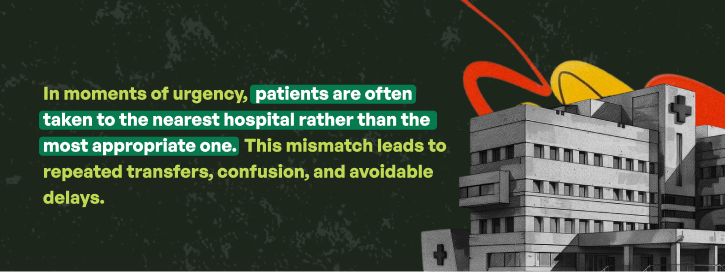
Beyond facility-based systems, emergency outcomes are also shaped by decisions made at the citizen level. In many emergency situations, bystanders, loved ones, and even first responders often lack clear visibility into which healthcare facilities are actually equipped to handle specific emergencies. The reality is that not all hospitals are fully prepared for emergencies. Some are not equipped for trauma care, others cannot manage cardiac arrest, obstetric emergencies, or paediatric crises. Yet in moments of urgency, patients are often taken to the nearest hospital rather than the most appropriate one. This mismatch leads to repeated transfers, confusion, and avoidable delays.
We saw this reality again in a case involving a road traffic accident victim and the CTO of Bumpa. Emergency responders moved between multiple hospitals without clear knowledge of which facility could provide immediate trauma care. Each transfer added more delay, and in emergency medicine, time lost is often irreversible. Sadly, this is not an isolated case. Situations like this happen far too often, where uncertainty at the point of decision becomes a silent contributor to poor outcomes.
This gap led to the development of First Response, a platform built around the idea of citizens as the decentralised first mile of healthcare. In emergencies, the moments before professional help arrives are often the most critical, yet communities are frequently left without the information or tools needed to act effectively. By equipping bystanders and first responders with real-time information, First Response helps bridge the gap between the onset of an emergency and access to appropriate care.
The platform enables faster decision-making by providing real-time hospital readiness mapping, GPS-based navigation, and emergency-type matching to identify the right facility for each situation. It also supports coordination between ambulances, volunteers, and healthcare providers, while providing immediate guidance to bystanders so that life-saving actions can begin before formal emergency services arrive.
Moving from Reactive to Predictive Emergency Systems
The future of emergency care cannot remain reactive. It has to be about anticipating needs before they become crises.
In practice, this means building systems that help healthcare providers see what is coming, not just respond to what has already happened. It means using data more intelligently across different parts of the health system, from oxygen demand to blood availability, and understanding which hospitals are actually ready to respond in real time.
When these layers come together—supply, logistics, and real-time visibility—emergency care becomes less about scrambling in the moment and more about being prepared ahead of time. It creates a system where readiness is built in, not improvised under pressure.
Policy Recommendations
At the federal level, the government should establish a National Emergency Care Coordination Centre with real-time visibility across hospital readiness, blood bank availability, and ambulance deployment. The National Blood Transfusion Service must be adequately funded. A dedicated emergency care budget line would provide predictable funding.
At the state level, each state should publish an Emergency Care Readiness Plan to map hospital capabilities and establish inter-facility transfer protocols. At the local level, primary healthcare centres should be equipped as stabilisation points with clear escalation pathways.
Civil society, the private sector, and technology innovators have demonstrated that the tools exist. The challenge is scaling these through regulatory frameworks, public-private partnerships, and sustained investment. Citizens should know their nearest emergency-ready facility and demand that governments publish emergency care readiness plans. By creating clear regulatory frameworks that allow private infrastructure engines to securely plug their real-time data into state and national command centres, we can scale these solutions rapidly.
Conclusion
Emergency care outcomes are not only determined by the availability of medical supplies but also by how well a system is designed to respond when every minute counts. When coordination breaks down, when readiness is unclear, or when information is missing, even available resources can become out of reach. These gaps are what turn treatable situations into avoidable loss.
LifeBank’s work sits within this reality, building the infrastructure that helps reduce the delay between emergency need and response, and strengthening the connections that allow healthcare systems to function under pressure. We will continue to innovate to ensure that no one loses their life due to a lack of access to safe, affordable, and timely medical supplies.
—
Temie Giwa Tubosun is the Group CEO of LifeBank, Africa’s healthcare supply chain engine. The company helps hospitals discover essential medical suppliers and delivers them in the right condition and on time. She has over 10 years of experience in health management with the Department for International Development (DFID), the World Health Organisation, the UNDP, and the Lagos State Government. In 2014, the BBC listed her among the 100 Women changing the world. She was also recognised as an African Innovator by Quartz and in 2025 as a social innovator of the year by the Schwab Foundation for Social Entrepreneurship.