

In recent years, through both my work and the realities I continue to observe, I have been drawn to a recurring question: who controls women’s bodies? Is it the state, society, or women themselves? These questions lie beneath many of the issues we confront, yet they are rarely addressed directly. In Nigeria, this tension is most visible in how sexual health is understood, accessed, and governed.
In 2019, I coordinated standstill rallies across eight northern states under the #NorthNormal campaign, pushing for the domestication of the Violence Against Persons Prohibition (VAPP) Act. In Sokoto, the police withdrew our permit. In Bauchi, the Speaker of the State House of Assembly, wearing an orange #ArewaMeToo shirt, received us and pledged support. In Borno, after sustained engagement with state lawmakers, we received a copy of a proposed VAPP domestication bill. These experiences taught me that the tensions around sexual health in Nigeria are not abstract policy debates. They play out in the everyday lives of women and girls, shaped by power, geography, and whether anyone with authority is willing to act.
The State of Sexual Health in Nigeria
Sexual health is often treated as a private or moral issue, something to be managed within families or avoided in public discourse. Yet the realities across the country tell a different story. For many women and girls, access to accurate information, reproductive health services, and protection from sexual violence remains uneven and, in some cases, entirely out of reach. These gaps are not accidental. They are shaped by policy limitations, cultural expectations, and systems that do not consistently centre women’s lived realities.
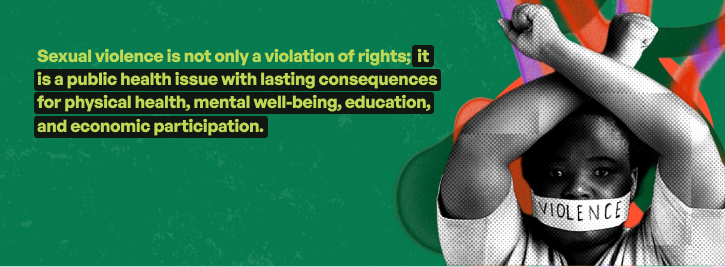
Nigeria continues to carry a high burden of maternal mortality, while adolescent pregnancy remains prevalent, particularly in rural and conflict-affected regions. Access to contraception is inconsistent, and conversations around sexuality are often constrained by social and religious sensitivities. At the same time, gender-based violence continues to shape women’s health outcomes in profound ways. Sexual violence is not only a violation of rights; it is a public health issue with lasting consequences for physical health, mental well-being, education, and economic participation.
The numbers are stark. According to the 2018 National Demographic and Health Survey, the maternal mortality ratio stands at 576 deaths per 100,000 live births, the fourth highest globally. In the North West, 36% of girls aged 15 to 19 have begun childbearing, compared with 6% in the South West. Modern contraceptive prevalence nationally is just 12%, dropping to as low as 3% in states like Sokoto. These are not just statistics. They represent the compounded consequences of systems that do not prioritise women’s reproductive autonomy.
Who Holds the Power, and Who Is Held Accountable?
Civil society organisations play a critical role in bridging these gaps, particularly in areas where formal systems fall short. In my work with the Anti-Sexual Violence Lead Support Initiative (ASVIOL), I have seen how survivors navigate not just trauma, but systems that are difficult to access, inconsistent, or, at times, unresponsive. For many women and girls, support does not come as a coordinated system but as fragmented interventions-a health facility in one place, legal support in another, and community stigma everywhere in between.
Development partners, including the World Bank and other international institutions, provide financing and technical support for programmes on maternal health, family planning, and gender-based violence. The private sector contributes through healthcare delivery and digital health platforms, although affordability remains a significant barrier. Across all of this, community and religious leaders continue to shape how sexual health is understood and whether services are accepted or not.
In 2025, ASVIOL launched the Seeds of Hope project in Tudun Biri, Kaduna State, a community devastated by the December 2023 military drone strike that killed over 100 residents. The project trains 50 women, survivors of conflict and gender-based violence, in climate-smart agriculture, addressing the root causes of vulnerability that make women susceptible to sexual violence in the first place.
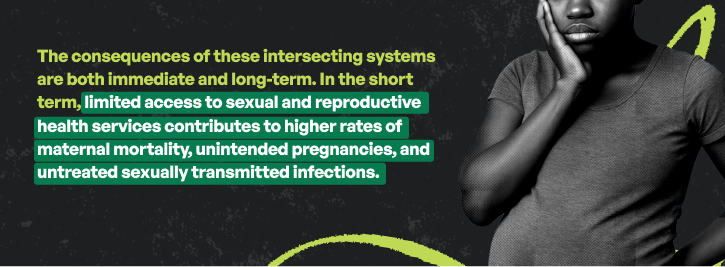
The consequences of these intersecting systems are both immediate and long-term. In the short term, limited access to sexual and reproductive health services contributes to higher rates of maternal mortality, unintended pregnancies, and untreated sexually transmitted infections. Gender-based violence continues to exact a devastating physical and psychological toll, particularly on women and girls in northern states, where access to justice and support services remains extremely limited.
The Cost of Exclusion: Short-Term Crisis, Long-Term Damage
Over time, these outcomes compound. Women who lack access to health services are less able to remain in school, enter the workforce, or build sustainable livelihoods. Gender-based violence deepens this reality. Survivors often face stigma, limited access to justice, and long-term trauma that affects their ability to participate fully in society.
As Nigeria confronts the challenge of creating jobs for a rapidly growing youth population, this cost becomes even more significant. Economic participation is not just about skills or access to finance; it is also about whether individuals can safely exist in the spaces where opportunities are created. Online gender-based violence, from threats to image-based abuse, is pushing many women into silence or withdrawal. A 2023 Paradigm Initiative study found that 58% of Nigerian women and girls surveyed had experienced some form of online gender-based violence. Yet Nigeria has no comprehensive legal framework to address online gender-based violence.
Sexual health, in this sense, is deeply connected to development. It shapes whether women can complete their education, work, build businesses, and create jobs for others. When women are excluded, whether through policy, social norms, or unsafe environments, the effects ripple through households, communities, and the broader economy.
Addressing this requires more than isolated interventions. It requires a coordinated approach that recognises sexual health as central to national development. The next section outlines what must change at the policy, institutional, and community levels.
What Must Change: Policy Recommendations
At the state level, there is a need to expand access to services in rural and underserved communities, invest in adolescent-friendly healthcare, and strengthen systems that connect health services with legal and social support for survivors. Local governments also have a critical role to play in community engagement-working with traditional and religious leaders to shift harmful norms and ensure that services are both accessible and acceptable.
Civil society must continue to provide survivor-centred support and drive accountability, while development partners can support data, financing, and programme design. The private sector has an important role in improving access to affordable services and ensuring that digital platforms are safer for women.
Ultimately, however, this is not only a policy issue. It is a question of how we understand power, autonomy, and participation in society.
Beyond Policy: A Question of Power
When women and girls are unable to make decisions about their own bodies, the consequences extend far beyond health. They shape education, economic opportunity, and the ability to participate fully in public life. As Nigeria approaches the 2027 elections, there is an opportunity to move beyond surface-level conversations and focus on the systems that shape everyday realities.
Sexual health must be recognised as central to those systems.
Because the question is not only whether women can access healthcare.
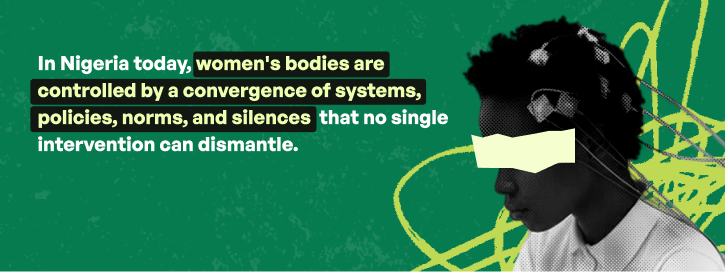
It is whether they can live, participate, and contribute fully — without their bodies being sites of control. The answer to the question this piece began with is uncomfortable but necessary: in Nigeria today, women’s bodies are controlled by a convergence of systems, policies, norms, and silences that no single intervention can dismantle. What is required is sustained political will, dedicated financing, and the kind of coordinated action that treats sexual health not as a sensitive topic to be managed but as a development priority that determines whether half the population can participate fully in the nation’s future.
—
Hassana Maina is a lawyer and gender advocate. She is the founder and Executive Director of the Anti-Sexual Violence Lead Support Initiative (ASVIOL), and a member of the World Bank’s inaugural IDA Youth Champions Circle. She holds a law degree from Ahmadu Bello University and a Master’s in Law, Development, and Globalisation from SOAS, University of London, with additional training from the University of Oxford’s Said Business School and the London School of Hygiene and Tropical Medicine. She has worked with UN Women across multiple Nigerian communities on gender-based violence prevention and response.